
Choosing an Indonesian charcoal exporter is one of the higher-risk sourcing decisions a B2B buyer makes. The supplier pool is large, the quality varies enormously, and the gap between a polished quotation and what actually arrives in your container can be wide. A spec sheet costs nothing to write. A container of charcoal that fails to match it costs you a customer.
This guide is a practical due-diligence checklist for evaluating any Indonesian charcoal exporter before you commit, built around what you can actually verify, not what a supplier claims.
Why Due Diligence Matters More with Charcoal
Hardwood charcoal is not a standardized commodity. Two suppliers can both label their product “premium hardwood charcoal” while shipping material with fixed carbon 15 percentage points apart. One burns hot and clean for hours; the other turns to ash and dust before the service is over. For a restaurant supply chain or a wholesale distributor, that difference is the difference between a repeat contract and a return.
The five checks below are how serious buyers separate exporters who can prove their quality from those who simply describe it.
Check 1
Independent Laboratory Data
The single most important verification is independent lab testing. A self-declared specification sheet is the supplier’s opinion. A Certificate of Analysis from an accredited laboratory is a fact.
Ask which laboratory tested the charcoal, and look for KAN (Komite Akreditasi Nasional) accreditation under ISO 17025:2017, the international standard for testing-laboratory competence. In Indonesia, PT. CARSURIN Tbk is the most widely recognized testing laboratory for charcoal.
For reference, here is the kind of verifiable data a credible exporter should be able to produce. PT. Salam Niaga Bakti’s Halaban Charcoal is tested under CARSURIN Report No. 240261.0008 (January 2024):
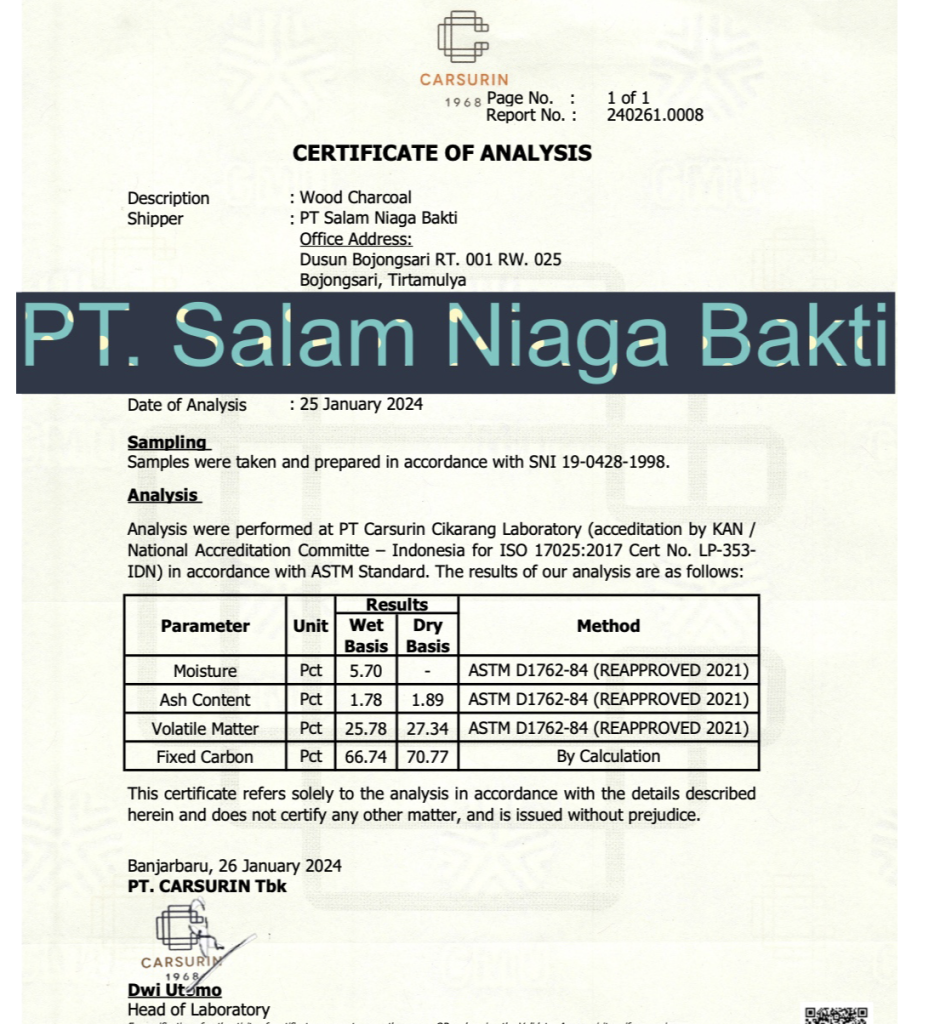
Our Arabika (Black Clamps) Charcoal is similarly certified under CARSURIN Report No. 201861.1004 (Fixed Carbon 68.92%, Ash 2.62%). Where a SKU has not yet completed independent testing, as is currently the case for our Ironwood Charcoal and Tamarind Charcoal, a trustworthy exporter says so plainly and publishes indicative figures rather than borrowing another product’s numbers. Transparency about what is and isn’t lab-verified is itself a due-diligence signal.
Check 2
Manufacturer or Broker?
Ask one direct question: “Do you produce this charcoal, or do you source it from other producers?”
There is nothing inherently wrong with a trading company, but you should know what you are dealing with. A direct manufacturer relationship usually means tighter quality control, more competitive pricing without an added margin layer, and traceability to a specific production batch. A broker reselling under its own label has less control over consistency from one container to the next.
PT. Salam Niaga Bakti works directly with charcoal producers in West Java and Kalimantan. Quality control happens at production, not just at the port, which is what makes batch-to-batch consistency possible.
Check 3
Container Loading Transparency
The container that arrives should match the sample you approved. The way to verify this before the vessel sails is loading documentation.
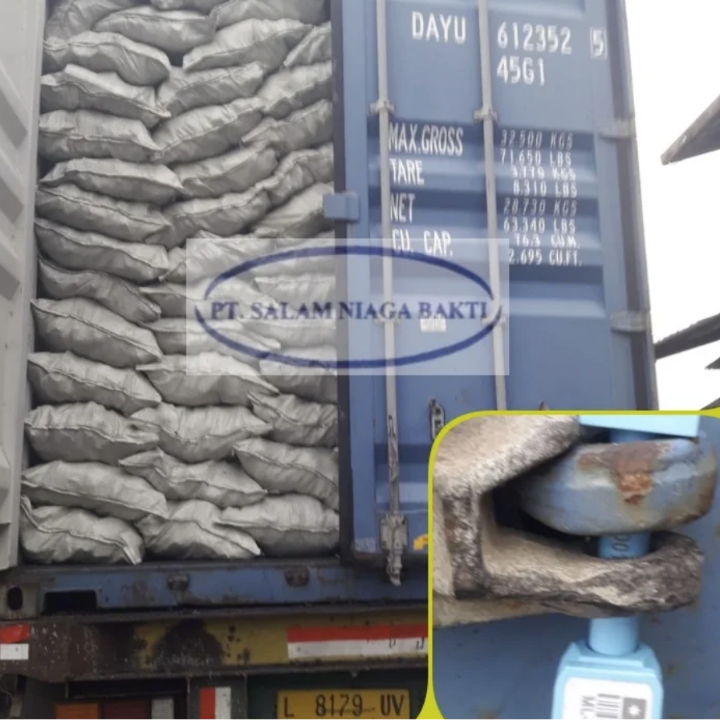
A reliable Indonesian charcoal exporter will provide, before the Bill of Lading is issued: container loading photos, a detailed packing list, the container number, and the seal number. If a supplier cannot or will not show you what went into the container, you are buying blind. This single practice prevents the most common sourcing failure, the sample meets spec, but the bulk shipment does not.
Check 4
Sample Before Bulk
No serious buyer should commit to a full container on the strength of a PDF. A credible exporter offers a representative sample, shipped via DHL or FedEx, before any bulk commitment and ships that sample with the relevant lab report attached.
Evaluate the sample against your own benchmark or your existing supplier. Test the burn. Check the ash. Confirm the lump size matches your application. The cost of a sample is trivial against the cost of a wrong container.
Sourcing from PT. Salam Niaga Bakti
We built our process around exactly these checks. Four hardwood charcoal SKUs: Halaban, Tamarind, Arabika (Black Clamps), and Ironwood. Shipped FOB Surabaya in 40′ High Cube Full Container Load, with CARSURIN lab data on our certified SKUs and full loading transparency on every shipment.
If you are evaluating an Indonesian charcoal exporter and want to run us through your own due diligence, request a sample and the relevant Certificate of Analysis. We would rather be verified than simply trusted.
Run your due diligence on us. Request a sample and lab report.