
Finding a reliable hardwood charcoal supplier for the Middle East is a different challenge from sourcing anywhere else. The region’s demand is enormous, hookah lounges, BBQ restaurants, grill houses, and retail all pull on the same supply chains and the buyers are experienced. Gulf importers have seen every kind of supplier, from serious exporters to opportunists who ship one good container and one bad one. The question is never just “who has charcoal.” It is “who can deliver the same charcoal, month after month.”
Why the Middle East Is a Demanding Charcoal Market
Charcoal in the Middle East is not a background commodity, it is part of the culture. Hookah and shisha lounges run charcoal continuously. BBQ and mishwi restaurants grill through long service hours. Retail demand spikes hard around Ramadan, Eid, and the cooler grilling season. That combination means two things for a supplier: volume has to be consistent, and quality has to be predictable.
An importer who receives one excellent container followed by an inconsistent one doesn’t just lose margin, they lose their own downstream customers. This is why the most important quality in a Middle East charcoal supplier is not a single impressive sample. It is repeatability.
What Gulf Importers Should Verify
Before signing with any hardwood charcoal supplier for the Middle East, confirm these four things.
1. Independent lab data — not a self-declared spec sheet. Ask which laboratory tested the charcoal, and look for KAN accreditation under ISO 17025:2017. In Indonesia, that means PT. CARSURIN Tbk. A number nobody independent measured is an opinion, not a specification.
2. Consistency across shipments. Ask directly whether the supplier is a direct manufacturer or a reseller. A direct manufacturer controls quality at production and can hold specifications steady batch to batch. A broker stitching together supply from multiple sources usually cannot.
3. Container loading transparency. Before the Bill of Lading, a serious supplier provides loading photos, a packing list, the container number, and the seal number. This is how you confirm that what you approved is what actually sailed.
4. Clear commercial terms in writing. MOQ, Incoterm, lead time, and payment terms should be on a pro forma invoice before you commit — not negotiated loosely over chat.
Where Arabika (Black Clamps) and Halaban Fit
PT. Salam Niaga Bakti supplies four hardwood charcoal SKUs. Two of them are already proven in the Middle East market.
Arabika (Black Clamps) Charcoal is our most Middle-East-established SKU. It is independently lab-certified by CARSURIN (Report No. 201861.1004):
With its distinctive lump form and a clean, stable burn, Arabika (Black Clamps) Charcoal suits both hookah lounges and BBQ supply. It is one of two SKUs we currently ship to our retainer buyer in Oman — so the packaging, lump size, and documentation are already optimized for Gulf importers.
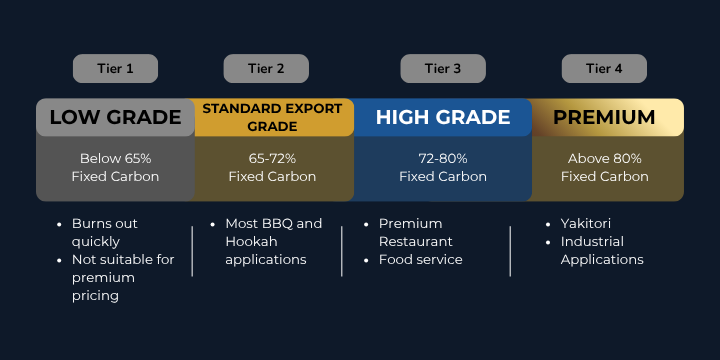
Halaban Charcoal is the step up for restaurants that grill hard. It carries the strongest lab profile in our range (CARSURIN Report No. 240261.0008): Fixed Carbon 70.77%, Ash 1.89%. That low ash figure means clean burning and no bitter taste — which is exactly what grill houses and restaurant supply chains look for.
For a Gulf importer building a range, the practical split is: Arabika (Black Clamps) for hookah and general BBQ, Halaban for premium restaurant grilling. Both burn consistently, and both come with a lab report you can hand to your own customers.
How We Ship to the Middle East
PT. Salam Niaga Bakti is a hardwood charcoal exporter based in West Java, Indonesia. We ship FOB Surabaya in 40′ High Cube Full Container Load — Arabika (Black Clamps) Charcoal at 23 metric tons per container, Halaban Charcoal at 20 MT.
Every shipment includes loading photos and a packing list before the Bill of Lading is issued. Our standard payment structure is T/T with a deposit and balance before shipment, and our lead time runs 14–21 days after PO and deposit. Approximate transit time from Surabaya to Gulf ports (Sohar, Jebel Ali, Dammam) is 14–21 days.
We already supply retainer buyers in Oman and the Czech Republic, and we are expanding across the wider Gulf. Because Oman is an established route for us, new Middle East buyers benefit from a supply chain that is already tested — not one we are figuring out for the first time.
The Bottom Line for Middle East Buyers
The Middle East doesn’t need another supplier with a good sample. It needs suppliers who can prove consistency and back it with lab data. That is the standard we hold ourselves to: independent CARSURIN certification on our established SKUs, direct-manufacturer sourcing, loading transparency on every container, and a track record in the region you can verify.
If you are sourcing hardwood charcoal for the Middle East, we will send you the CARSURIN report and a free sample so you can evaluate the burn before you commit.